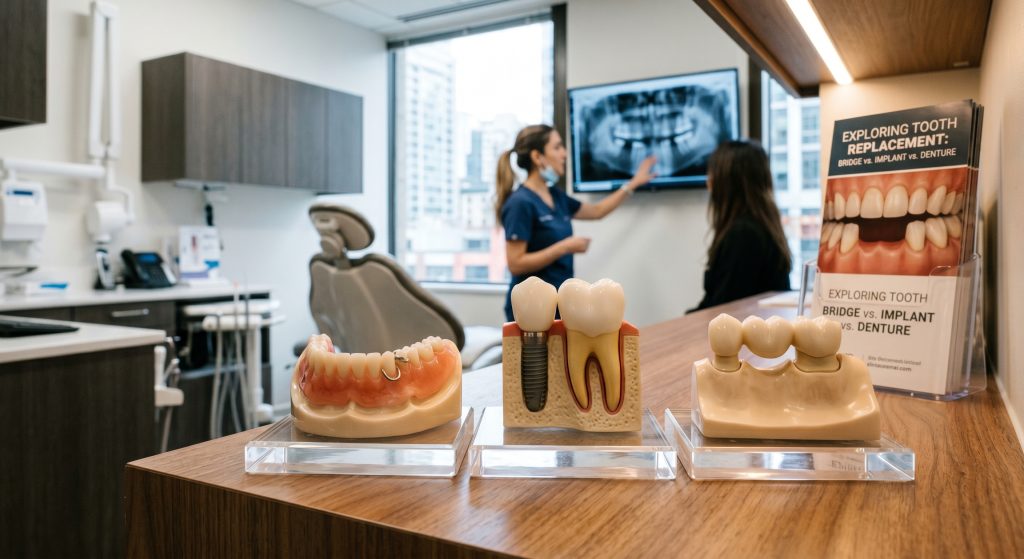
Losing a tooth changes more than your smile. It changes how you eat, how nearby teeth move over time, and how your jawbone holds its shape. The good news is that you have three reliable ways to replace a missing tooth: a bridge, an implant, or a denture.
Each one solves a different combination of problems. The right choice depends on how many teeth are missing, the health of your remaining teeth, your bone, and what you want long-term.
If you live or work in Downtown Vancouver and are weighing your options, here is a clear, side-by-side look at all three.
Why replacing a missing tooth matters
When a tooth is lost and not replaced, several things happen over time. The teeth on either side may drift into the gap. The opposing tooth may grow up or down to meet the empty space. The jawbone in that area starts to shrink because it no longer gets the stimulation it once did from chewing.
None of this happens overnight, but the longer the gap is left, the more complex any future replacement becomes. Replacing a missing tooth, even when it is not visible, helps protect the rest of your bite.
At-a-glance comparison
| Feature | Bridge | Implant | Denture |
|---|---|---|---|
| Best for | 1 to 3 in a row, healthy neighbours | 1 or a few, with healthy bone | Many missing or full arch |
| Affects neighbouring teeth | Yes, they need crowns | No | Partial may rest on adjacent teeth |
| Surgery required | No | Yes | No, unless implant-supported |
| Helps preserve bone | No | Yes | No (unless implant-supported) |
| Removable | No | No | Usually yes |
| Typical lifespan | 10 to 15 years | 20+ years, often lifetime | 5 to 10 years, with relines |
| Total treatment time | 2 to 3 weeks | 3 to 6 months on average | 4 to 8 weeks |
| Relative cost | Middle | Highest upfront | Lowest upfront |
Option 1: Dental bridge
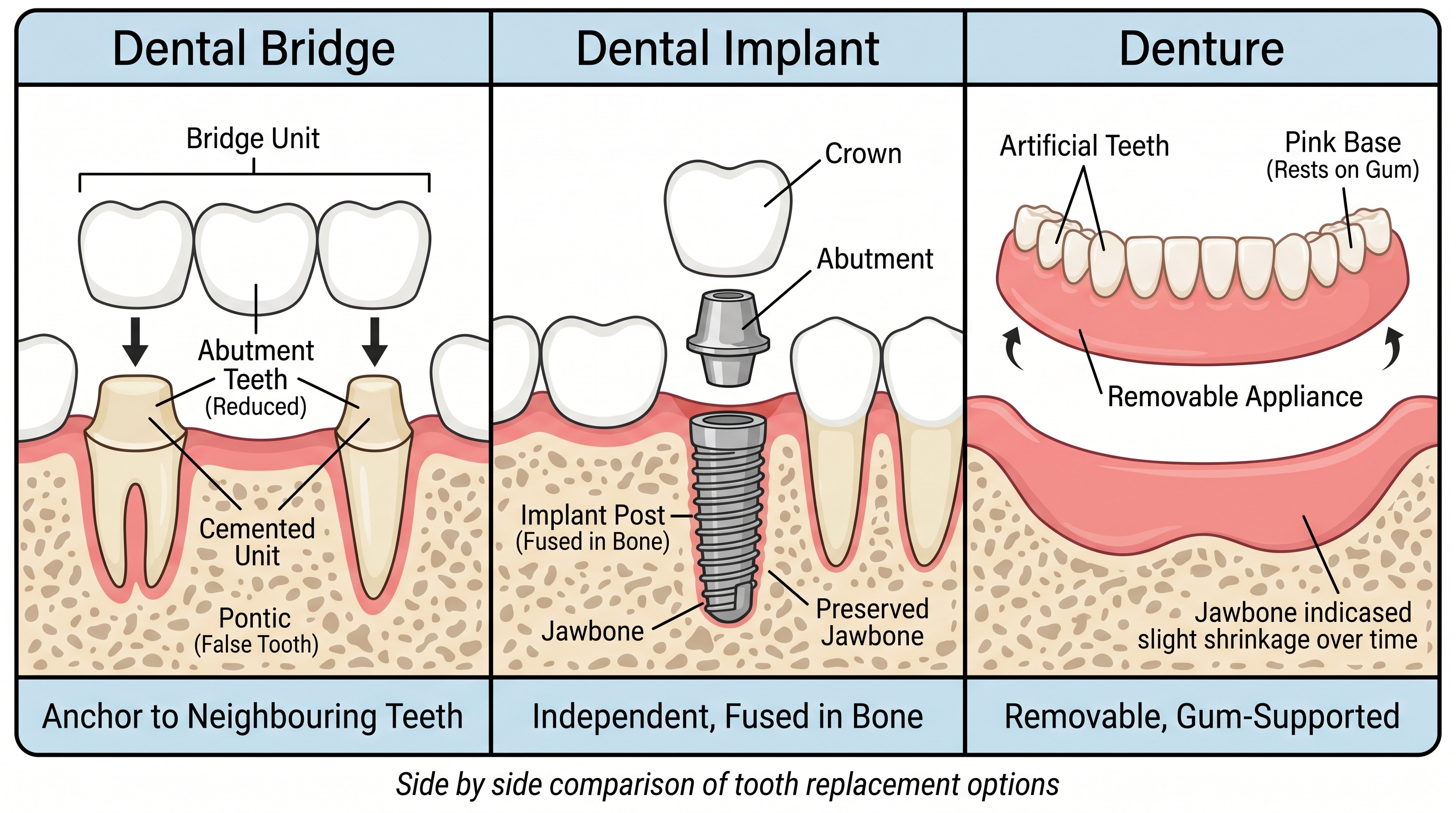
A dental bridge fills a gap by anchoring a false tooth to crowns on the teeth on either side. The two crowns and the false tooth are joined together as a single piece that is cemented in place. It does not come out.
Pros
- No surgery required
- Fixed in place, feels like a natural tooth
- Faster than implants
- Often partially covered by insurance
Cons
- Healthy enamel must be reduced on neighbouring teeth
- Does not stop bone loss in the gap
- Cleaning under the bridge requires special floss
- If one supporting tooth fails, the whole bridge usually needs to be replaced
A bridge is often a strong choice when the neighbouring teeth already need crowns. In that case, you are getting two needed crowns plus a tooth replacement in one piece.
Option 2: Dental implant
A dental implant is a small titanium post that takes the place of the missing tooth’s root. It is placed in the jawbone during a short surgery. After the bone heals around it, a custom crown is attached on top. The implant is independent: it does not depend on neighbouring teeth.
Pros
- Does not affect neighbouring teeth
- Helps preserve the jawbone in that area
- Feels and functions most like a natural tooth
- Longest lifespan of the three options
Cons
- Surgery is required
- Healing takes several months
- Highest upfront cost
- Smoking, uncontrolled diabetes, or low bone volume can complicate the case
If you want the option that protects bone and feels closest to a natural tooth, an implant is usually the strongest choice when your case is suitable.
Option 3: Dentures
Dentures are removable replacements for missing teeth. A complete denture replaces all the teeth in an arch. A partial denture replaces a few missing teeth and clips onto the remaining ones. Dentures rest on the gums and, for partials, on the natural teeth.
Pros
- Most affordable upfront
- No surgery for traditional dentures
- Replaces many teeth at once
- Removable for cleaning
Cons
- Less stable than fixed options, especially on lower jaw
- Some patients find chewing certain foods harder
- The fit changes over time as gums and bone change
- Need daily cleaning and overnight soaking
Today’s dentures are also more flexible than they used to be. Implant-supported dentures, sometimes called overdentures, snap onto a small number of implants for much better stability while still being removable. They are a hybrid option worth asking about.
How to choose between them
Start with the situation in your mouth. The right answer often becomes clear once you describe your case in plain terms.
If 1 or 2 teeth are missing and your neighbours are healthy
An implant is usually the strongest choice. It does not require touching the healthy neighbouring teeth and helps preserve bone in the gap.
If 1 to 3 teeth are missing and the neighbours need crowns anyway
A bridge can be efficient. Two crowns plus a replacement tooth, all in one piece, often comes out at a similar cost or less than separate procedures.
If many teeth are missing or you have a full arch to replace
A complete denture, a partial denture, or implant-supported dentures usually make the most sense. Implant-supported options can dramatically improve stability if you have enough bone.
If cost is the deciding factor
Dentures have the lowest upfront cost. Bridges sit in the middle. Implants cost more upfront but often have the longest lifespan. Comparing cost per year sometimes changes the picture.
If you want the most natural feel
Implants typically come closest to a natural tooth. There is nothing to take in or out, and the feeling when chewing is usually indistinguishable from a real tooth once healing is complete.
Combining options
Some patients benefit from a combination. Examples include:
- A few implants to anchor a partial denture, giving it the stability of a fixed option
- An implant in one location plus a bridge in another, depending on the health of each area
- Starting with a denture while planning for implants over time
Combinations are common and let you balance comfort, function, and cost in a way that fits your life.
Cost: how to think about it
Exact pricing depends on the case, but the order is fairly consistent. Dentures have the lowest starting cost. Bridges sit in the middle. Implants are the highest upfront. Implant-supported dentures fall between traditional dentures and full implant cases.
Most insurance plans offer some coverage for bridges and dentures. Implant coverage varies more widely. It is worth asking your provider for an estimate and getting a written treatment plan before any work begins.
What to expect at a tooth replacement consultation
A consultation is part conversation, part exam. Expect:
- An exam of the missing area, neighbouring teeth, and gums
- A bite assessment and review of any habits like grinding
- X-rays and often a 3D scan to check bone volume and shape
- A clear explanation of which options would and would not work, and why
- A written quote and timeline before any treatment is booked
If you have not had a recent exam, a starting dental checkup often makes the planning more accurate.
Comfort options if you feel anxious
Tooth replacement, especially anything involving surgery, can feel intimidating. If anxiety has been keeping you from booking, ask about sedation dentistry. Different levels of sedation are available depending on your medical history and how nervous you feel. Knowing the option exists is often enough to make the next step feel manageable.
When to see a dentist sooner
Book a visit if any of the following apply:
- You recently lost a tooth or had one removed
- A bridge or denture you already have feels loose or uncomfortable
- Your bite has shifted, or you notice teeth tilting toward a gap
- It has been a year or more since your last exam and you have a missing tooth
- You are considering implants and want to know whether you have enough bone
Seek urgent care for facial swelling, fever near the missing area, severe pain, or a tooth that was just knocked out from trauma. For situations like these, contact us right away for emergency dentistry.
Care after tooth replacement
Each option has slightly different maintenance, but the basics are similar:
- Brush twice a day and floss daily, with special tools for under bridges and around implants
- For dentures, clean every day and soak overnight in a denture cleaner
- Keep up with regular professional cleanings and exams
- If you grind or clench, ask your dentist about a night guard to protect your work
- Mention any sore spots, looseness, or changes in bite at your visits
Why patients trust us with tooth replacement decisions
We do not push any one option. We start by understanding what you want long-term, then look at the actual condition of your teeth, gums, and bone using digital imaging. Our team explains the trade-offs in plain language so you can choose with confidence.
Our Downtown Vancouver clinic offers transparent fees, direct billing with most insurance providers, CDCP support where eligible, and sedation options for patients who feel anxious about surgical or longer procedures.
Get a clear plan for your missing tooth
Book a consultation with our Downtown Vancouver team. We will examine your case, take the right images, and walk you through which option fits your situation best.
Frequently asked questions
Which is best: a bridge, an implant, or a denture?
There is no single best option. Implants are usually best for replacing one or a few missing teeth when neighbouring teeth are healthy. Bridges work well when neighbouring teeth already need crowns or have large fillings. Dentures are often the right choice for replacing many missing teeth or a full arch.
How long does each option last?
A traditional bridge typically lasts 10 to 15 years with good care. A dental implant commonly lasts 20 years or longer, often a lifetime. Dentures usually need adjustment or relining every few years and replacement around every 5 to 10 years.
Are dental implants worth the higher cost?
For many patients, yes. Implants do not affect neighbouring teeth, help preserve jawbone, and feel the most like a natural tooth. They cost more upfront, but their longer lifespan often makes the cost per year similar or lower than other options.
Can I get a dental implant if I have been missing the tooth for years?
Often yes, but the longer a tooth has been missing, the more the bone in that area can shrink. A 3D scan tells your dentist whether you have enough bone for an implant or whether bone grafting is needed first. Many Vancouver patients with long-standing missing teeth still proceed successfully with implants.
Will dental insurance cover bridges, implants, or dentures in Vancouver?
Most plans offer some coverage for bridges and dentures because they are considered restorative care. Implant coverage varies more widely. Coverage details depend on your plan, so it is worth asking your provider for an estimate before treatment.
What happens if I leave a missing tooth untreated?
Over time, neighbouring teeth may drift into the gap, the opposing tooth may grow toward the empty space, and the jawbone in that area can shrink. The longer the gap is left, the more complex future treatment becomes.
This article is for general information only and does not replace personal advice from your dentist. Outcomes, lifespans, and pricing vary by case. A clinical exam, X-rays, and a 3D scan are the most reliable way to choose the right option for you.